
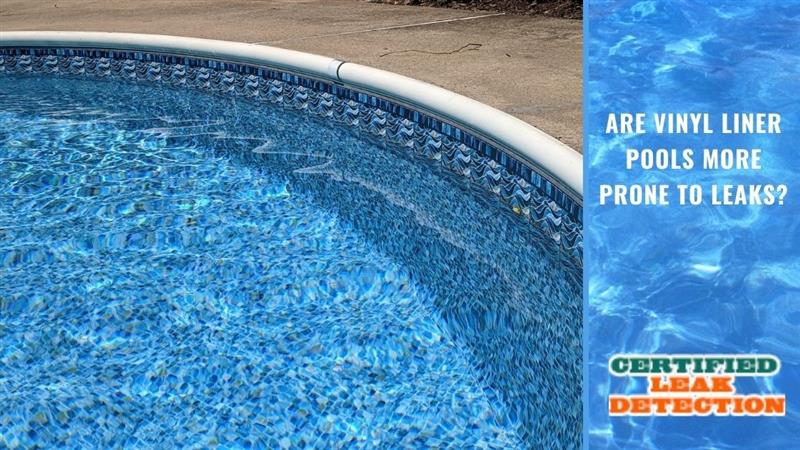
If you own — or are considering installing — a vinyl liner pool, you may have heard that they’re “more likely to leak” than other types of pools. But is that actually true?
The short answer: Vinyl liner pools aren’t necessarily more prone to leaks — but they do leak differently than concrete or fiberglass pools. Understanding how and why leaks occur can help you protect your investment and avoid costly damage.
Common Causes of Leaks in Vinyl Liner Pools
Unlike concrete or fiberglass pools, vinyl liner pools use a custom-fit liner that sits inside a structural frame (typically steel, polymer, or aluminum panels). The liner acts as a waterproof barrier that holds the water in place. Because the liner itself is flexible and relatively thin, it is more vulnerable to certain types of damage. However, this doesn’t mean that leaks are inevitable. Proper maintenance is key to preventing the conditions that cause leaks.
Common causes of leaks in vinyl liner pools include the following:
Tears and punctures — Vinyl liners can be punctured by sharp objects — such as toys, pool equipment and pet claws; fallen tree branches; improper vacuum heads or maintenance tools; and shifting ladder or step hardware. Even small tears can allow water to escape gradually.
Seam separation — The manufacturing process for vinyl liners involves heat-welding multiple sheets of vinyl material together. Over time, seams may weaken due to age and UV exposure, chemical imbalance, ground movement, or manufacturing defects. When seams separate, leaks can develop along those joints.
Aging and material degradation — As the plasticizers that keep the vinyl flexible degrade — primarily due to UV exposure and chemical imbalance — the liner becomes prone to fading, wrinkles, tears, and leaks. This breakdown typically leads to a loss of elasticity, brittleness, and structural failure, generally within a 7- to 15-year lifespan.
Fitting and gasket failure — Leaks in vinyl liner pools often occur around skimmers, return jets, pool lights and main drains. These components rely on gaskets and seals to prevent water from escaping. Over time, those seals can deteriorate and allow water to leak behind the liner.
As you’ve seen, we’ve mentioned unbalanced water chemistry as a cause of vinyl liner pool leaks. The good people at Cool Breeze Pools explains this in detail.
“Improper chemical balance ranks as the number one enemy of vinyl pool liners. High chlorine levels (above 3 ppm) directly attack vinyl material, causing it to break down and lose elasticity over time. Similarly, low pH levels (below 7.2) create acidic conditions that can eat away at the liner material.
“The damage happens quickly — a pH below 7.0 maintained for just 24-48 hours can begin permanent degradation of your liner. High calcium hardness levels lead to scaling and staining, whereas low levels make the water aggressive toward vinyl. Maintaining balanced chemistry isn’t just about water clarity — it’s fundamentally about protecting your liner investment.”
How Vinyl Pool Leaks Differ from Concrete or Fiberglass Pool Leaks
Here is some good news for vinyl pool owners! Vinyl liner leaks are typically caused by damage to the liner itself, such as punctures, slices and seam failures. Leaks in concrete pools can stem from structural cracks in the plaster, shell, or around plumbing fittings. Fiberglass pool leaks tend to occur at plumbing fittings rather than in the shell itself.
Minor punctures and tears in the liner are relatively easy and inexpensive to repair — but only up to a point. As mentioned earlier, depending upon such factors as environment and use, the vinyl liner itself must be replaced every seven to 15 years — which isn’t inexpensive. Even so, while vinyl liner pools have different leak risks than concrete, they are not automatically more problematic.
Our blog post — “What You Need to Know About Vinyl Liner Pools” — covers this topic — as well as many others — in greater detail.
Signs Your Vinyl Liner Pool May Have a Leak
Most of the tell-tale signs that your vinyl liner pool has a leak apply to all pools. Watch out for rapid water loss that evaporation can’t account for (as well as higher water bills); soft or sinking spots around the pool; and air bubbles in the return lines.
Particular to vinyl liner pools, a wrinkling liner is a common indicator of a pool leak — specifically water escaping and gathering underneath the liner, causing it to float and shift. While leaks are a major cause, wrinkles also result from ground water issues, extreme chemical imbalances (low pH/high chlorine), or, in some cases, aging and shifting.
If you think your vinyl liner pool is leaking, performing some basic DIY troubleshooting tests can confirm your suspicion or ease your mind. The famous “bucket test” helps determine if your pool is losing water due to a leak, or evaporation. Our website has a page with step-by-step instructions for performing the bucket test, the pool pump on-off test, and a test to find if a leak is occurring in the pool plumbing or the pool interior.
Dye-testing your pool with food coloring is another option. Our blog post – “Five Ways to Detect a Pool Leak” – provides instructions for performing this test (as well as the bucket test). If there is a leak, you will see the colored water leaving the pool from that area. You can put additional drops of food coloring into the pool around areas where you think there might be a leak – such as a skimmer gasket, light fixtures and the drain opening. If you suspect a leak on the floor of the pool, perform the food coloring test to locate its exact position. Dispense a few drops of colored water on the area where you suspect the leak, and the dye will soon exit from the location of the leak.
If your DIY test finds the source of the leak, small tears or rips can be patched with a vinyl patch kit, or a flexible liquid sealer. Small leaks in vinyl liners or pipes can be repaired using a pool and spa sealer. Such products are available at pool and spa supply stores, as well as online. Follow manufacturer’s instructions for use.
The Take-Home Message
Although vinyl liner pools don’t quite deserve their reputation for being more prone to leaks than other types of pools, they do require a little extra care and maintenance to prevent damage that can cause leaks. Doing so on a regular schedule will allow it to provide many years of fun, and keep your pool a great asset to your property. Our blog post —“How to Maintain a Vinyl Liner Pool” — provides a comprehensive guide on everything you need to know!
Despite your best efforts, your vinyl liner pool may still develop a leak. Some leaks are easy to find, but there are many that pool owners can’t detect without professional assistance. Certified Leak Detection uses technology and techniques we have developed over 20 years in business. In addition to quick detection and repair of swimming pool leaks, we provide industry-leading leak detection and repair for spas and hot tubs. Serving areas throughout Central Florida – including Orlando, Longwood, Lake Mary, Sanford, Kissimmee, Clermont and Winter Springs – our team is ready to answer your call. Contact us for quick, reliable service!